

Understanding Industrial Air Compression Needs
In the modern industrial landscape, selecting the right air compression technology is not merely a technical choice; it is a strategic business decision that impacts energy consumption, maintenance budgets, and production reliability. Two of the most prominent technologies dominating the high-capacity market are the centrifugal air compressor and the rotary screw compressor. While both systems serve the purpose of delivering pressurized air, their mechanical designs, operational efficiencies, and application suitability differ significantly. Facilities must weigh these factors carefully to ensure long-term operational success.
The demand for high-quality, oil-free air is at an all-time high, particularly in sectors such as pharmaceuticals, food and beverage, and electronics manufacturing. Here, the choice of a centrifugal air compressor often emerges as the superior solution for large-scale, continuous operations. However, for smaller-scale tasks or intermittent demand, the rotary screw compressor offers versatility that cannot be overlooked. This guide provides a deep dive into the technical nuances of these two giants, helping you navigate the complexities of air system design and procurement with confidence.
At Biaofang, we understand that every factory floor has unique requirements. Whether you are aiming for peak energy efficiency or looking for a robust system that can handle harsh environments, understanding the fundamental differences between these technologies is the first step. By analyzing performance curves, maintenance intervals, and lifecycle costs, we can determine which machine provides the best return on investment for your specific site conditions.
Working Principles: Dynamic vs. Positive Displacement
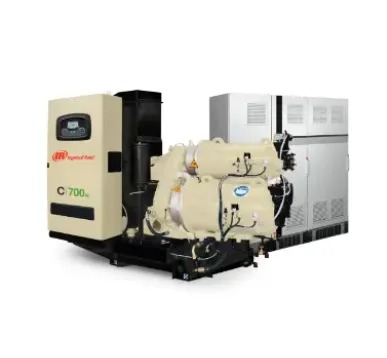
The primary distinction between these two technologies lies in how they compress air. A centrifugal air compressor is a dynamic machine that uses a series of high-speed impellers to impart kinetic energy to the air. As the air passes through the impeller and into the stationary diffuser, that kinetic energy is converted into pressure. This process is continuous and allows for massive volumes of air to be processed within a relatively compact footprint. Because there are no rubbing parts in the compression stages, these machines are inherently oil-free, making them ideal for sensitive applications.
In contrast, the rotary screw compressor operates on the principle of positive displacement. It utilizes two intermeshing helical rotors to trap a specific volume of air and reduce its volume as it moves along the length of the rotors. This reduction in volume results in an increase in pressure. Screw compressors can be either oil-flooded or oil-free. Oil-flooded versions use lubricant to seal the gaps between the rotors and cool the air, while oil-free versions use high-precision timing gears and specialized coatings to prevent metal-to-metal contact. The mechanical action of a screw compressor is highly effective for variable flow but typically cannot match the raw volume capacity of a large-scale dynamic system.
From a technical perspective, the centrifugal design is better suited for steady-state, high-demand scenarios. The speed at which the impellers rotate—often exceeding 30,000 RPM—requires precision engineering and sophisticated control systems. These units thrive when running at or near their design point. Conversely, the screw compressor is generally more tolerant of frequent start-stop cycles or fluctuating demand, provided it is equipped with a variable speed drive (VSD). Understanding these basic mechanical differences is essential for anyone evaluating the long-term viability of their compressed air infrastructure.
Performance Efficiency and Flow Dynamics
When evaluating efficiency, the centrifugal air compressor is often the champion of large-scale industrial plants. Its ability to provide high-volume flow with exceptional specific power (kW/100 CFM) at full load is unmatched. This makes it the preferred choice for "base-load" applications where the air demand remains constant throughout the day. The aerodynamic design of the impellers ensures that energy losses are minimized, and multi-stage designs with intercooling further enhance thermodynamic efficiency by bringing the air temperature closer to the ambient level between stages.
Rotary screw compressors, however, excel in flexibility. While a single-stage screw compressor might have lower peak efficiency than a multi-stage centrifugal unit, modern two-stage screw designs have significantly closed the gap. The real advantage of the screw compressor appears in partial-load scenarios. When air demand drops, a VSD-equipped screw compressor can slow down to match the exact requirement, maintaining relatively high efficiency. A centrifugal unit has a limited "turndown" range; if demand drops below its surge point, the machine must blow off excess air to atmosphere or recirculate it, which is energetically wasteful.
It is also important to consider the impact of environmental conditions. The performance of a centrifugal machine is highly sensitive to changes in inlet air temperature and pressure. On hot, humid days, the density of the air decreases, requiring the impellers to work harder to maintain the same discharge pressure. Screw compressors are generally less sensitive to these atmospheric changes. Therefore, a hybrid approach—using a centrifugal air compressor for the base load and a VSD screw compressor for trim—is often the most energy-efficient strategy for large facilities with varying demand profiles.
Maintenance Lifecycle and Long-term Reliability
Maintenance is a significant component of the Total Cost of Ownership (TCO). One of the most attractive features of the centrifugal air compressor is its simplified internal architecture. Since there are no contact parts in the compression stages (impellers don't touch the casing), there is virtually no wear and tear in the traditional sense. The main maintenance items include air filters, oil filters for the gearbox, and cooling water treatment. With proper care, the core components of a centrifugal machine can last for decades without requiring a major overhaul.
Rotary screw compressors have a different maintenance profile. In oil-flooded units, the lubricant must be changed regularly, and oil separators must be replaced to prevent downstream contamination. Even in oil-free screw models, the rotors are often coated with Teflon or other materials that can wear down over time, eventually leading to a loss of efficiency and the need for an air-end replacement. Typically, a screw air-end has a service life of 40,000 to 60,000 hours, after which a costly rebuild or replacement is necessary. This contrasts with the centrifugal design, where "rebuilding" usually involves cleaning and bearing inspection rather than replacing the entire compression module.
However, it must be noted that when a centrifugal compressor does require a repair, it often requires specialized technicians and precision balancing. It is not a machine that can be serviced by a general mechanic. Reliability is high, but it depends heavily on the quality of the cooling water and the cleanliness of the intake air. A single large dust particle or a surge event can cause catastrophic damage to high-speed impellers. Therefore, investing in high-quality filtration and advanced monitoring systems, such as those provided by Biaofang, is essential for protecting these high-value assets.
Biaofang: Your Partner in Advanced Compressed Air Solutions
As a leading provider in the industry, Biaofang specializes in delivering high-performance compression systems tailored to the most demanding industrial environments. We pride ourselves on our deep technical expertise and our comprehensive range of products, including genuine parts and complete machine solutions from world-renowned brands like Ingersoll Rand. Whether you are looking for a state-of-the-art centrifugal air compressor or a highly efficient oil-flooded rotary screw compressors system, our team is equipped to guide you through every step of the selection process.
Our advantage lies in our holistic approach to air system management. We don't just sell machines; we provide solutions that maximize uptime and minimize energy waste. Our inventory includes a vast array of components, from Ingersoll Rand air compressor parts to specialized centrifugal compressor units. By choosing Biaofang, you gain access to a global supply chain and a local support team that understands the critical nature of your production line. We ensure that every piece of equipment we supply meets the highest standards of quality and performance.
Furthermore, Biaofang offers expert consultation on system optimization. We help clients evaluate their existing setups to identify bottlenecks and energy leaks. Our goal is to ensure that your investment in a centrifugal air compressor pays for itself through reduced utility bills and increased productivity. With a focus on innovation and customer satisfaction, Biaofang remains the preferred choice for industries worldwide seeking reliable and efficient compressed air technology.
Frequently Asked Questions
Q1: When is a centrifugal air compressor better than a screw compressor?
A centrifugal air compressor is ideal for large-scale operations requiring continuous, high-volume, and 100% oil-free air. It is most efficient when used as a base-load machine in industries like power generation, textiles, and chemical processing.
Q2: What is the typical turndown ratio for a centrifugal air compressor?
Typically, a centrifugal air compressor has a turndown range of 20% to 30%. Beyond this point, the machine may experience surging, which requires the use of bypass valves or blow-off valves to protect the mechanical integrity of the unit.
Q3: How does the initial cost of a centrifugal air compressor compare to a screw model?
The initial capital investment for a centrifugal air compressor is generally higher than that of a rotary screw compressor of equivalent power. However, for high-capacity applications, the lower energy consumption and reduced maintenance costs often result in a lower total lifecycle cost.
Q4: Can a centrifugal air compressor handle variable air demand?
While they are primarily designed for steady demand, a centrifugal air compressor can handle some variability through inlet guide vane (IGV) adjustment. For highly fluctuating loads, it is best to pair them with a screw compressor or a storage system.
Q5: Is the air from a centrifugal air compressor always oil-free?
Yes, by design, the compression chambers of a centrifugal air compressor do not require any lubricant. This ensures that the air delivered is inherently oil-free, meeting the strict Class 0 certification requirements for sensitive industries.
Optimize Your Air System Today
Choosing the right technology is the key to industrial efficiency. Whether you need a high-volume centrifugal system or a versatile screw compressor, Biaofang has the expertise to help you succeed.